
I’ve been doing research into what the daily lives of historic gothic heroines might have looked like in those rare periods of stability when they weren’t running from castles or finding extra wives hidden in the attic. Part of this has involved reading “The Mirror of the Graces”, a 19th century guidebook on how to groom, dress, and conduct yourself like An Appropriate Young Lady tm, and let me tell you, it has been an experience. Originally I hadn’t planned on writing anything specific about this one book but in order to keep my sanity as I continue to wade through it I’ve decided to share some particular extracts with you. This may end up being a part one. We’ll see.
God wants you to get dressed up. But not too much.

I’m only on the introduction. But it’s a long introduction. In which our Lady of Distinction references such luminaries as Dr. Knox (the famously woman hating Dr. Knox of Calvinist fame? Unclear) to justify her claim that God actually wants women specifically to be exactly the right amount of fashionable and pretty.
“God created the body, not only for usefulness, but adorned it with loveliness; and what he has made so pleasing, shall we disesteem, and refuse to apply to its admirable destination? — The very approving and innocent complacency we all feel in the contemplation of beauty, whether it be that of a landscape or of a flower, is a sufficient witness that the pleasure which pervades our hearts at the sight of human charms, was planted there by the Divine Framer of all things, as a principle of delight and social attraction. To this end, then, I seek to turn your attention, my fair countrywomen, upon YOURSELVES! — not only to the cultivation of your minds, but to maintain in its intended station that inferior part of yourselves, which mistaken gravity would, on the one hand, lead you to neglect as altogether worthless; and vanity, on the other, incline you too much to cherish, and egregiously to over-value.”
Really she’s doing everyone a public service by writing this book. She says so herself.
“Mothers, perhaps, (those estimable mothers who value the souls as the better parts of their daughters,) may start at such a text. But I call them to recollect, that it is “good all things should be in order!” This is a period when absurdity, bad taste, shamelessness, and self-interest, in the shapes of tire-men and tire-women, have arranged themselves in close siege around the beauty, and even chastity, of your daughters; and to preserve these graces in their original purity, I, a woman of virtue and a Christian, do not think it beneath my dignity to lift my pen.”
Women, and their clothing, are responsible for mens’ behaviour.

“ Having been a traveller in my youth, whilst visiting foreign courts with my husband, on an errand connected with the general welfare of nations, I could not overlook the influence which the women of every country hold over the morals and happiness of the opposite sex in every rank and degree.
Fine taste in apparel I have ever seen the companion of pure morals, whilst a licentious style of dress was as certainly the token of the like laxity in manners and conduct. To correct this dangerous fashion, ought to be the study and attempt of every mother — of every daughter — of every woman.”
I’m still in the introduction. I am very tired.
The author is an Ancient Greek-aboo
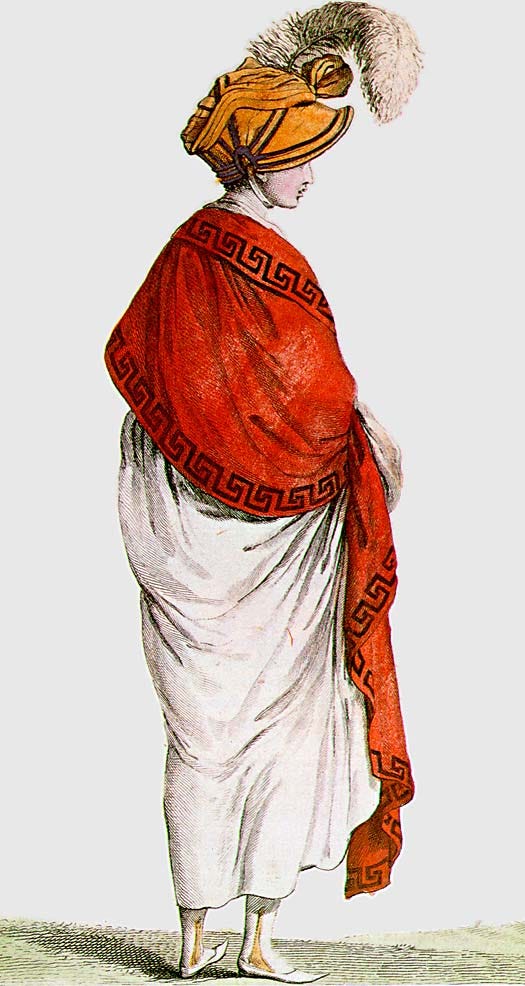
“But even at that period, when the east and south laid their decorating riches at the feet of woman, we see, by the sculpture yet remaining to us, that the dames of Greece (the then exemplars of the world) were true to the simple laws of just taste. The amply-folding robe, cast round the harmonious form; the modest clasp and zone on the bosom; the braided hair, or the veiled head; these were the fashions alike of the wife of a Phocion, and the mistress of an Alcibiades. A chastened taste ruled at their toilets; and from that hour to this, the forms and modes of Greece have been those of the poet, the sculptor, and the painter.”
To be fair everyone in the West was something of a Classics-aboo at this point, but I do think she takes it a little far even compared to her peers. The entire second chapter is a mix of this and scathing diatribes about the ills of other eras’ and regions’ fashions.
“Thence, by a natural descent, have we the iron boddice, stiff farthingale, and spiral coiffure, of the middle ages. The courts of Charlemagne, of our Edwards, Henries, and Elizabeth, all exhibit the figures of women as if in a state of siege. Such lines of circumvallation and outworks; such impregnable bulwarks of whale-bone, wood, and steel; such impassable mazes of gold, silver, silk, and furbelows, met a man’s view, that, before he had time to guess it was a woman that he saw, she had passed from his sight; and he only formed a vague wish on the subject, by hearing, from an interested father or brother, that the moving castle was one of the softer sex.”
I don’t actually have a complaint about that section. I think it’s hilarious.
“But it was not till the accession of the House of Brunswick, that it was finally exploded, and gave way by degrees to the ancient mode of female fortification, by introducing the hideous Parisian fashion of hoops, buckram stays, waists to the hips, screwed to the circumference of a wasp, brocaded silks stiff with gold, shoes with heels so high as to set the wearer on her toes; and heads, for quantity of false hair, either horse or human, and height to outweigh, and perhaps outreach, the Tower of Babel!”
The anti-monarchist French satirists would have agreed. I suspect knowing this fact would have given her a heart attack.
“The health-destroying boddice was laid aside; brocades and whale-bone disappeared; and the easy shape and flowing drapery again resumed the rights of nature and of grace.”
This I find interesting because it’s anti-corset sentiment pre-dating the Victorian era and the various dress reform movements it spawned. There’s a perception that corset hatred is entirely a product of Victorian dress reform movements and modern Hollywood misrepresentation, but clearly it was a normative enough opinion in the Regency era that women like our dear Lady here felt confident publishing it for all to see.
I think I’m going to stop here for now as this is getting long. I’ve only finished the second chapter though, so there’s definitely going to be a part two.
 Gothic Auntie
Leave a comment