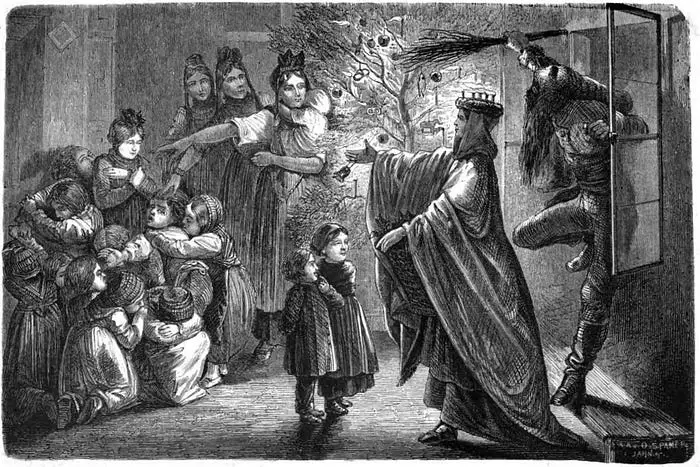
Santa has some scary friends. We all know about Krampus by now, the hairy goat-demon from the Alps, but it turns out he’s just the tip of the iceberg when it comes to Father Christmas’ European enforcers. Meet Hans Trapp, the undead cannibal scarecrow who terrorises children in Alsace, France.
Surprisingly, of all Santa’s terrifying henchman, Hans Trapp is the one genuinely based on a real person. Hans von Trotha was a German knight, awarded control of two castles in 1480 by the Prince Elector of the Palatinate while Alsace was part of the Germanic Holy Roman Empire. The only problem was that Berwartstein Castle, which von Troth had made his primary seat, had previously belonged to the local Abbey, and it’s annexation thirty years later was a matter for dispute.
Already furious that what he saw as the Abbey’s rightful property had been given to a foreigner, the final straw for the Abbot came when von Troth demanded they hand over the estate traditionally attached to the castle too. The Abbot appealed to the local Elector for help, only for the Elector to decided in von Troth’s favour, awarding him a higher rank as well as the rest of the castle’s estate (for a reasonable price of course). This wasn’t the end of it however, and the dispute between the monks and von Troth only escalated, with von Troth resorting to levels of truly cartoonish villainy in an attempt to get his way.
The most egregious of von Troth’s verified evil acts (we’ll get to the unverified ones in a moment) was when he decided to dam up the local river, flooding the Abbot’s lands and cutting off the water supply for the nearby town in the process. When the monks pleaded with him to restore the town’s water to them it apparently gave von Trotha ideas. Instead of removing the dam in a safe, controlled fashion he decided to just rip it out quickly, violently flooding Wissembourg and dealing immense damage that the inhabitants would take years to recover from.
Hans got away with this behaviour for eight years because, though the Abbot sent regular appeals to the Holy Roman Emperor, his imperial majesty didn’t feel especially moved to do anything about it. Finally the Abbot decided to go over his head and write to the pope for help, at which point von Trotha finally made a mistake.
Rather than attending the papal summons, which was, after all, all the way down in Rome and very inconvenient to get to, Hans decided to send the pope a letter instead. A rude letter. One in which he accused the pope — accurately, though that’s beside the point — of immorality. Hans likely thought the power of the Holy Roman Empire and his position within it would continue to shield him from any consequences. Instead he found himself excommunicated, and subject to an Imperial Ban that forced him to take up a diplomatic role at the royal court in France.
Despite his excommunication and exile von Trotha retained possession of his lands and castles, and was even able to return there in order die at Berwartstein Castle in 1503. Absence did not make the peoples’ hearts grow fonder however, and the legend of his iniquities began to grow with each retelling until he became something of a local cryptid, with very little in common with his original self.
Renamed Hans Trapp, from the word trappen, to walk loudly in order to scare off ghosts and spirits, Hans was now said to have entered into a pact with the devil. Far from spending his exile in a cushy role at the French court he was now believed to have spent it roaming the Alsatian countryside in search of victims. Filled with an insatiable lust for human flesh he disguised himself as a scarecrow in order to lure children close enough to grab, only to drag them off into the dark forests around Castle Berwartstein so he could cook and eat them in peace.
Eventually Trapp’s evil became so great that God wasn’t willing to tolerate it anymore and struck him dead with a bolt of lightning. This after he had killed and roasted a young shepherd boy over the fire but before he’d managed to eat him. The matter of God drawing the line at cannibalism rather than child murder is certainly an interesting one, but something something mysterious ways not for us to know.
This lightning bolt wasn’t to be the end of Hans Trapp though, because, and the stories vary on this one, either St. Nicholas or Jesus Christ himself then chose to raise the man from the dead. There are so many theological questions raised by this story and absolutely zero answers.
After being raised from the dead however Hans found his true vocation, as one of the companions of St. Nicholas, punishing bad behaviour among the children of Alsace as the saint rewards the good. Some accounts portray this as his having had a radical come to Jesus moment, with his participation in the Christmas prize and punishment sphere all about teaching children right from wrong. Others see it as a way for him to continue doing what he truly loved, marking out children to kill and eat over the coming year, with bad children going on the list.
You can see Hans Trapp every year at the Night Parade of Hans Trapp and Christkindl in Wissembourg, where the villain parades through the town accompanied by fire eaters and a wheeled cage full of children begging for rescue. Eventually Christkindl arrives and Hans Trapp is frightened off by the light of God, fleeing back to his castle lair for another year according to local folklore. The spectacle takes place on the 4th Sunday in Advent, December 22nd this year, so if you want to really terrorise your children there’s still time to make it happen.
 Gothic Auntie
Leave a comment